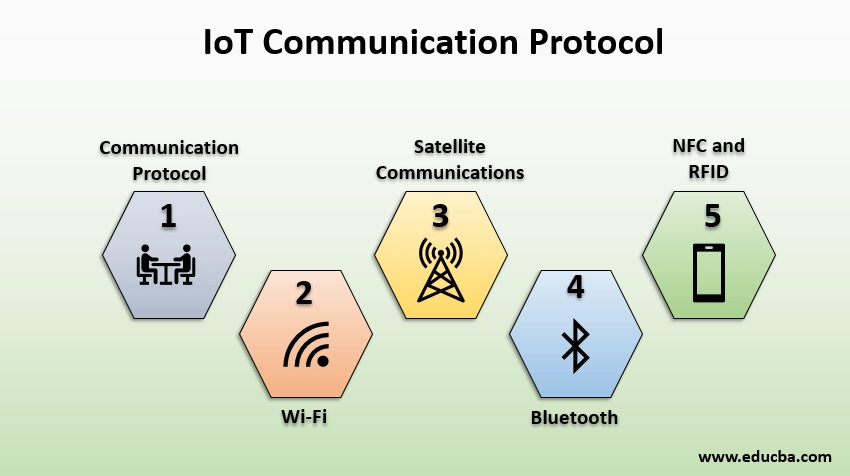
The Internet of Things (IoT) protocols are the communication rules that permit related devices, sensors, gateways, servers, and cloud systems to trade facts. IoT gadgets can range from smart bulbs and thermostats to commercial machines, medical devices, cars, and agricultural sensors.
Without appropriate protocols, an IoT device can’t reliably deliver sensor information, receive instructions, or communicate with other devices. Different IoT programs require one-of-a-kind protocols because of the truth they will have special requirements for power consumption, bandwidth, range, latency, reliability, safety, and scalability.
IoT Protocols at a Glance
| Protocol | Communication Model | Typical Network | Main Use |
|---|---|---|---|
| MQTT | Publish/Subscribe | Internet/TCP/IP | IoT messaging |
| CoAP | Request/Response | UDP/IP | Constrained devices |
| HTTP/HTTPS | Request/Response | Internet/TCP/IP | Web and cloud communication |
| AMQP | Messaging | TCP/IP | Enterprise messaging |
| DDS | Data-centric Publish/Subscribe | IP networks | Industrial and real-time systems |
| WebSocket | Persistent two-way communication | TCP/IP | Real-time applications |
| LoRaWAN | Low-power wide-area | LPWAN | Long-range sensors |
| Zigbee | Mesh networking | Local wireless | Smart homes and automation |
| Thread | IPv6 mesh | Local wireless | Smart home devices |
| Bluetooth LE | Short-range wireless | Personal area | Wearables and sensors |
| Z-Wave | Mesh networking | Local wireless | Smart home automation |
| NB-IoT | Cellular IoT | Cellular network | Low-power connected devices |
| LTE-M | Cellular IoT | Cellular network | Mobile and connected devices |
What Are IoT Protocols?
An IoT protocol defines how records are exchanged among related devices and other systems.
For instance, a temperature sensor might also moreover furthermore diploma a room at ordinary intervals. The tool uses a communication protocol to transmit that temperature reading to a gateway or cloud application. The receiving system ought to recognize the protocol and data format before it can process the information.
IoT communication can seem amongst:
Device → Device
Device → Gateway
Device → Cloud
Device → Application
Cloud → Device
Different protocols may also function at one in every of a number of levels of this communication system.
Why Are IoT Protocols Important?
IoT networks can include hundreds or tens of hundreds of thousands of gadgets. Many of these gadgets have limited memory, processing power, battery capacity, and network bandwidth.
A suitable protocol can assist offer:
| Requirement | Importance |
|---|---|
| Low Bandwidth | Reduces network usage |
| Low Power | Extends battery life |
| Reliability | Reduces communication failures |
| Security | Protects data and devices |
| Scalability | Supports large device deployments |
| Low Latency | Enables faster responses |
| Interoperability | Helps different systems communicate |
| Long Range | Supports remote devices |
Selecting the wrong protocol can boost battery usage, network charges, latency, or device complexity.
Main Categories of IoT Protocols
IoT protocols can be grouped in keeping with how they communicate and where they’ll be used.
Messaging Protocols
These protocols are designed to exchange messages among devices, applications, and servers.
Common examples include:
- MQTT
- AMQP
- DDS
Application Protocols
These protocols provide techniques for packages and devices to alternate facts.
Common examples include:
- HTTP
- HTTPS
- CoAP
- WebSocket
Wireless IoT Protocols
These technologies are usually used to attach physical IoT devices.
Examples encompass:
- Bluetooth Low Energy
- Zigbee
- Thread
- Z-Wave
- LoRaWAN
- NB-IoT
- LTE-M
MQTT
MQTT, or Message Queuing Telemetry Transport, is one of the most widely recognized application-layer protocols for IoT messaging.
It uses a post/subscribe version. Instead of sending data right now from one device to another, a device can post data to a topic through a broker. Other gadgets or packages can be a part of that topic.
MQTT Structure
| Component | Function |
|---|---|
| Publisher | Sends data |
| Subscriber | Receives data |
| Broker | Manages messages |
| Topic | Identifies the message channel |
| Payload | Contains the actual data |
For example, a temperature sensor may additionally want to publish data to:
home/bed room/temperature
An application subscribed to that topic can gather the temperature readings.
MQTT Quality of Service
MQTT offers 3 QoS levels.
| QoS | Meaning | Use Case |
|---|---|---|
| 0 | At most once | Frequent sensor readings |
| 1 | At least once | Important device messages |
| 2 | Exactly once | Messages where duplicates should be avoided |
MQTT is specifically useful even as gadgets have limited bandwidth or unreliable network connections.
CoAP
CoAP, or Constrained Application Protocol, is designed for constrained devices and networks.
It follows a request/reaction technique similar in concept to internet communication but is designed with resource-restricted devices in mind.
CoAP Characteristics
| Feature | Description |
|---|---|
| Design | Lightweight |
| Communication | Request/Response |
| Common Transport | UDP |
| Device Type | Constrained devices |
| Architecture | REST-based |
| Typical Use | Sensors and embedded systems |
CoAP is beneficial at the same time as an IoT tool provides a lightweight method for having access to or controlling devices.
HTTP and HTTPS
HTTP is the basis of much of the internet and is likewise applied in IoT systems.
An IoT device can deliver information to an internet server the usage of HTTP requests. HTTPS provides encrypted communique the use of TLS.
HTTP in IoT
| Function | Example |
|---|---|
| Device Data Upload | Sensor sends readings |
| API Communication | Device communicates with cloud |
| Configuration | Application sends settings |
| Status Checking | Server requests device information |
| Firmware Services | Connected platform manages updates |
HTTP is broadly supported, but it may have more communication overhead than lightweight IoT messaging protocols.
AMQP
AMQP, or Advanced Message Queuing Protocol, is designed for dependable messaging between packages and services.
It is regularly associated with enterprise systems, cloud structures, and applications that require established messaging and reliable delivery.
AMQP Features
| Feature | Description |
|---|---|
| Messaging | Structured message exchange |
| Reliability | Supports reliable communication |
| Routing | Messages can be routed between systems |
| Security | Supports secure implementations |
| Transactions | Supports transactional messaging |
| Enterprise Use | Suitable for business systems |
AMQP can be beneficial at the same time as IoT facts desires to flow into larger business applications.
DDS
DDS, or Data Distribution Service, is a statistics-centric put up/subscribe verbal exchange preferred designed for systems that require real-time data distribution and real Quality of Service controls.
It is specifically applicable to programs on the side of:
- Industrial automation
- Robotics
- Autonomous structures
- Transportation
- Defense structures
- Healthcare device
- Smart infrastructure
DDS Features
| Feature | Description |
|---|---|
| Data-Centric | Focuses on data distribution |
| Publish/Subscribe | Supports distributed communication |
| Real-Time | Suitable for time-sensitive systems |
| QoS | Extensive configuration options |
| Discovery | Supports automatic participant discovery |
| Scalability | Designed for distributed systems |
DDS is usually more feature-rich and complex than lightweight IoT messaging protocols.
Challenges of IoT Protocols
| Challenge | Explanation |
|---|---|
| Fragmentation | Many technologies and standards exist |
| Security | Connected devices increase the attack surface |
| Compatibility | Devices may use different ecosystems |
| Power Limits | Battery devices need efficient communication |
| Network Reliability | Wireless networks can suffer interference |
| Scalability | Large deployments require careful architecture |
| Management | Thousands of devices need monitoring |
| Updates | Devices need long-term maintenance |
Future of IoT Protocols
IoT communication is more and more transferring in the direction of IP-based connectivity, lower power consumption, more potent safety, component computing, interoperability, and more realistic tool management.
Modern smart-home environments are also increasingly combining wireless mesh networking with utility-layer requirements. In commercial environments, predictable data distribution and Quality of Service continue to be critical.
Artificial intelligence is likewise transforming IoT architectures. Sensors can increasingly generate data that is analyzed at the edge in order to send every piece of raw information to the cloud.
Conclusion
Internet of Things (IoT) protocols shape the communication foundation of related gadgets. They decide how sensors, machines, gateways, cloud structures, and programs exchange facts.
MQTT is widely relevant to lightweight messaging, CoAP is designed for constrained IP devices, HTTP/HTTPS works well with network and cloud applications, AMQP is useful for hooked up employer messaging, and DDS is appropriate for disturbing actual-time and distributed systems.