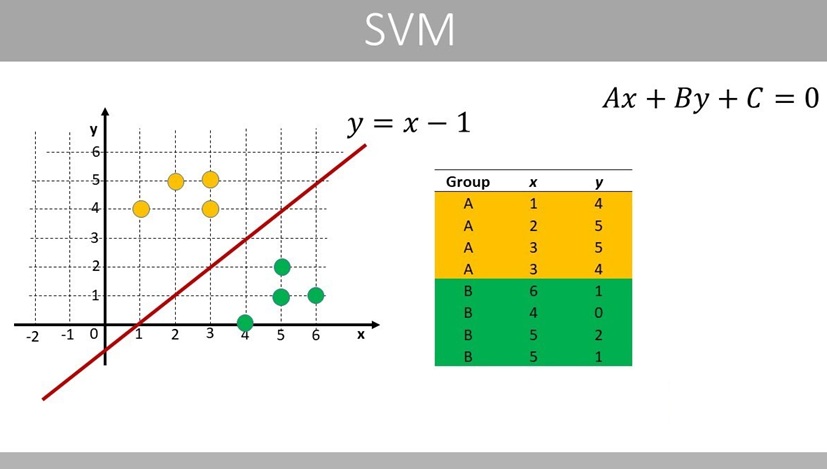
SVM in Machine Learning: Support Vector Machine (SVM) is one of the most well-known supervised system studying algorithms used for sophistication and regression tasks. It is broadly recognized for its functionality to categorise data effectively, in particular at the same time as jogging with high-dimensional datasets. Because of its robust performance and mathematical foundation, SVM is normally applied in fields along with photo reputation, textual content class, clinical analysis, and fraud detection.
What Is SVM in Machine Learning?
SVM stands for Support Vector Machine. It is a supervised machine learning algorithm that analyzes information and determines the optimal boundary (referred to as a hyperplane) to cut up awesome education.
The main goal of SVM is to maximise the space, called the margin, between the nearest elements. These nearest elements are called support vectors, and they play an important role in building the model.
Key Components of SVM
Understanding the following concepts makes SVM easier to study.
Hypermodel
A hyperplane is the decision boundary that separates one-of-a-kind training data.
- In 2 dimensions, it is a line.
- In 3 dimensions, it is a plane.
- In higher dimensions, it is referred to as a hyperplane.
The set of regular concepts chooses the hyperplane that creates the widest margin amongst commands.
Support Vectors
Support vectors are the information facdataosest to the decision boundary.
These factors decide the position of the hyperplane. If support vectors trade, the decision boundary can also rulesrulesy change.
Margin
The margin is the space between the hyperplane and the nearest support vectors.
A big margin typically results in higher category-approved model performance.
How Does SVM Work?
SVM follows these crucial steps:
- Receive decision-related education statistics.
- Identify the vectors.
- Find the line that separates classes.
- Maximise the margin so the instruction results
- Use the classification accuracy model to categorise overall statistics.
If the records cannot be separated using an instant line, SVM makes use of mathematical transformations known as kernel functions to create nonlinear decision boundaries.
Types of SVM
There are number one sorts of Support Vector Machines.
Linear SVM
Linear SVM is used whenthe statistics may be separated using a straight line or hyperplane.
Example:
- Positive opinions
- Negative critiques
If functions are virtually decisionted, Linear SVM performs very well.
Non-Linear SVM
When the data can’t be separated linearly, Non-Linear SVM uses kernel techniques to map the information right right i-dimensional space.
This makes it much less hard to break up complicated datasets.
Kernel Functions in SVM
Kernel functions allow SVM to solve nonlinear classification problems.
Linear Kernel
Best for linearly separable datasets.
Polynomial Kernel
Useful when relationships among variables are polynomial.
Radial Basis Function Kernel
The maximum typically used kernel as it handles complex data successfully.
Sigmoid Kernel
Works further to neural network activation abilities in certain situations.
SVM Classification when
Imagine a dataset containing sorts of fruits:
- Apples
- Oranges
Each fruit is represented through abilities which includes:
- Weight
- Color
- Diameter
SVM analyzes these features and creates a classification network that separates apples from oranges. When a current-day fruit is introduced, SVM predicts its class based totally on which issue of the boundary it falls.
SVM for Regression
Although SVM is specifically designed for classification, it could alsofeaturesression responsibilities.
This version is referred to as Support Vector Regression (SVR).
SVR predicts non-discrete values in preference to classification.
Examples embody:
- House price prediction
- Stock price estimation
- Temperature forecasting
- designeddesignededictclassificatclassification
Advantages of SVM
Support Vector Machine gives several benefits
High Accuracy
SVM frequently produces great results, mainly for non-linear data
Effective in High-Dimensional Linear Regression
It performs well even if the dataset consists of many features.
Memory Efficient
Only guide vectors are used to define the version, lowering memory usage.
Handles Nonlinear Data
Kernel capabilities allow SVM to categorise complicated datasets.
Less Risk of Overfitting
With proper parameter tuning, SVM generalizes nicely to unseen data
Disadvantages of SVM
Despite its strengths, SVM has a few barriers.
Slow on Large Datasets
Training becomes computationally pricey with tens of tens of hundreds of thousands of facts.
Parameter Selection
Choosing the appropriate kernel and tuning parameters like C and gamma can be difficult.
Limited Interpretability
Compared to decision trees, SVM models are more difficult to interpret.
Less Suitable for Noisy Data
Datasets with overlapping instructions or many outliers can reduce overall performance.
Applications of SVM
SVM is widely used throughout many industries.
Image Recognition
Identifying images, written digits, and medical images.
Spam Detection
Filtering undesirable emails based mostly on message content cloth.
Medical Diagnosis
Classifying diseaseaffected-symptom-based diagnostic data.
Text Classification
Categorizing documents, information articles, and client evaluations.
Fraud Detection
Detecting suspicious financial transaction data and banking fraud.
Bioinformatics
Analyzing DNA sequences, proteins, and genetic facts.
Handwriting Recognition
Recognizing handwritten characters and signatures.
SVM vs Logistic Regression
| Feature | SVM | Logistic Regression |
|---|---|---|
| Main Use | Classification | Classification |
| Accuracy | Often higher for complex data | Good for simple datasets |
| Decision Boundary | Maximum margin | Probability-based |
| Nonlinear Support | Yes (using kernels) | Limited without feature engineering |
| Speed | Slower on very large datasets | Faster on large datasets |
SVM vs Decision Tree
| Feature | SVM | Decision Tree |
|---|---|---|
| Accuracy | High | Moderate to High |
| Interpretability | Lower | High |
| Handles Nonlinear Data | Yes (with kernels) | Yes |
| Overfitting Risk | Lower with tuning | Higher without pruning |
| Training Speed | Slower | Faster |
When Should You Use SVM?
SVM is an incredible choice at the same time as:
- Your dataset has a clear separation between classes.
- The number of features is large.
- The dataset is small to medium in size.
- High class accuracy is crucial.
- You need a sturdy model for text or photo classification.
For rather huge datasets, algorithms such as Random Forest, XGBoost, or deep learning models can classify more successfully.
Real-World Examples of SVM
Some realistic uses include:
- Email filtering
- Face reputation systems
- Disease prediction
- Credit card fraud detection
- Customer sentiment assessment
- Optical character recognition (OCR)
- Product recommendation aid
- Cybersecurity threat detection
These packages display SVM’s versatility across numerous domains.
Conclusion
Support Vector Machine (SVM) is one of the most effective supervised system gaining knowledge of algorithms for kind and regression duties. By locating the maximum suited hyperplane with the maximum margin, SVM offers accurate and reliable predictions, specifically for immoderate-dimensional records. Its potential to model patterns makes it appropriate for fixing each linear and nonlinear troubles.
Although SVM may be slower on very large datasets and requires cautious parameter tuning, it stays a valuable set of policies for many real-world applications, along with spam detection, scientific analysis, and fraud detection. Learniproblemsproblems offers a robust foundation for knowledge greater superior device reading techniques.
Frequently Asked Questions
1. What is SVM in machine learning?
SVM (Support Vector Machine) is a supervised anlearning algorithmsed on the whole for sophistication and regression with the aid of using locating the maximum extremely good selection boundary between classes. data
2. What is the entire shape of SVM?
The complete form of SVM is Support Vector Machine.
3. What are support vectors?
Support vectors are the data points closest to the decision boundary. They decide the vicinity of the maximum appropriate hyperplane.
4. What is a kernel in SVM?
A kernel is a mathematical function that transforms data into a higher-dimensional space, allowing SVM to categorize data points.
5. Whatdecisionfference among SVM and SVR?
SVM is mainly used for classification, whilst Support Vector Regression (SVR) is used for predicting non-linear functions
6. Where is SVM utilized in real life? Higher-dimensional
SVM is utilized in direct mail filtering, photograph recognition, medical diagnosis, text classification fraud detectio,,n, h,,andwrdetectionssification, and bioinformatics.