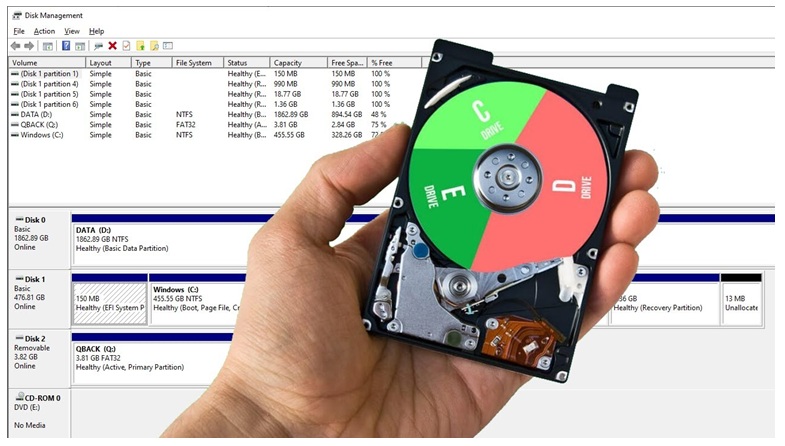
If your pc has only one large force, creating separate walls assist you organize files, improve data management, and make reinstalling Windows an awful lot less complicated. Many clients look for a manner to partition tough disk because they need separate drives for Windows, personal documents, video games, or work files without purchasing another storage tool.
What Is a Hard Disk Partition?
A hard disk partition is a segment of your storage device that Windows treats as a separate drive. For example, one physical hard disk can be divided into a couple of partitions, such as:
- C: Drive for Windows
- D: Drive for Personal Files
- E: Drive for Games
- F: Drive for Backups
Although they’ll be on the same physical drive, each partition works like an unbiased garage location.
Why Should You Partition a Hard Disk
Partitioning gives several benefits.
Better File Organization
You can separate your working device from private documents, making the whole lot less complex.
Easier Windows Reinstallation
If Windows needs to be reinstalled, your private files saved on each other partition are a lot a good deal less probable to be affected.
Improved Data Management
Separate drives assist in organizing files, pics, films, and software more successfully.
Better Backup Planning
You can all over again up critical partitions without copying the entire hard drive.
Things to Do Before Partitioning
Before you start, take a look at these precautions:
- Back up essential documents.
- Ensure there is sufficient free disk space.
- Close unnecessary programs.
- Avoid interrupting the partition process.
- Keep your laptop connected to the power if using a battery.
These steps reduce the threat of data loss.
How to Partition Hard Disk Using Disk Management
Windows includes an integrated tool known as Disk Management.
Step 1: Open Disk Management
- Press Windows + X
- Select Disk Management
You’ll see all to be had garage drives and partitions.
Step 2: Shrink an Existing Partition
If your strain has unfastened region:
- Right-click on the partition you need to reduce.
- Select Shrink Volume.
- Windows calculates to be had reduce back location.
- Enter the amount of space to reduce.
- Click Shrink.
After a few moments, unallocated space will appear.
Step 3: Create a New Partition
Once unallocated space is available:
- Right-click the unallocated space.
- Select New Simple Volume.
- Click Next.
- Choose the partition length.
- Assign a drive letter.
- Format the partition using NTFS.
- Finish the wizard.
Windows will now create the new volume.
How to Partition a New Hard Drive
If you have set up a new hard drive:
- Open Disk Management.
- Initialize the disk if prompted.
- Choose GPT (advocated for modern PCs) or MBR for older systems.
- Create a New Simple Volume.
- Format the partition.
- Assign a drive letter.
The force is then prepared to use.
Understanding File Systems
When growing a partition, Windows asks you to pick a file system.
NTFS
- Best for Windows
- Supports big documents
- Recommended for most customers
exFAT
- Good for external drives
- Works on multiple running systems
FAT32
- Compatible with older gadgets
- Cannot store files larger than four GB
For internal Windows drives, NTFS is commonly the preferred choice.
How Much Space Should You Allocate?
The perfect partition length depends on your drive needs
A commonplace setup consists of:
| Partition | Recommended Size |
|---|---|
| Windows (C:) | 150–250 GB |
| Personal Files (D:) | Remaining Space |
| Games (Optional) | 100 GB or more |
| Backup (Optional) | Based on storage needs |
This configuration maintains your system organized and flexible
Can You Resize Partitions Later?
Yes. Windows Disk Management allows you to:
- Shrink walls
- Extend partitions (if adjoining unallocated area is available)
- Delete partitions
- Create new walls
Always back up essential files in advance of making crucial changes.
Common Partition Mistakes to Avoid
Many customers by chance create problems at the same time as partitioning.
Avoid those mistakes:
- Not backing up crucial files
- Deleting the incorrect partition
- Interrupting the partition method
- Creating too many small walls
- Formatting the system partition by way of the use of mistake
Double-take a look at each step in advance than confirming changes.
Is Partitioning Safe?
Yes. Partitioning is normally completed effectively using Windows Disk Management.
However, there can be continuously a small chance at the same time as improving disk systems. Creating a backup before making modifications is strongly endorsed.
SSD vs HDD Partitioning
The partitioning method is sort of identical for both SSDs and HDDs.
SSD
- Faster average performance
- Quicker partition operations
- Better software program loading
HDD
- Slower than SSD
- Larger capacities regularly available
- Suitable for long-term storage
Both may be partitioned using the same Windows tools.
Benefits of Multiple Partitions
Creating multiple partitions gives numerous benefits:
- Better organisation
- Easier backups
- Improved document management
- Cleaner Windows installation
- Separate paintings and personal facts
- Simplified recovery way
Many specialists use a couple of walls for those reasons.
When Should You Avoid Partitioning?
Partitioning may not be vital if:
- Your force is almost complete.
- You have very confined storage functionality.
- You use cloud storage for critical files.
- You already have multiple physical drives.
In those conditions, partitioning may not provide much gain.
Tips for Managing Partitions
Follow these awesome practices:
- Keep at least 20% free space on each partition.
- Avoid filling the system to the point of stress.
- Store personal files one by one from Windows.
- Back up vital data regularly.
- Label partitions with large namesthat includes “Work,” “Photos,” or “Backup.”
These behaviors assist in maintaining an organized storage system.
Conclusion
Learning the manner to partition tough disk is a beneficial potential for every Windows user. By dividing your storage into separate sections, you may organize files better, simplify backups, and make future Windows installations simpler. Windows Disk Management offers a secure and smooth way to create, resize, and control walls with out installing additional software program application software program.
Before making any changes, continually once more up essential data and plan your partition sizes carefully. With the right technique, partitioning can enhance each consolation and lengthy-term garage manage.
Frequently Asked Questions
What is a hard disk partition?
A hard disk partition is a separate phase of a storage drive that functions as an unbiased force in Windows.
Can I partition a hard disk with out dropping facts?
Yes. Windows Disk Management lets you reduce an existing partition and create a new one without deleting your files; however, we should note that backing up important files is usually recommended.
Which file gadget want to I pick?
NTFS is the recommended file system for most Windows users because it allows big documents and advanced protection features.
Is partitioning an SSD safe?
Yes. SSDs may be partitioned nicely the usage of Windows Disk Management, much like traditional hard drives.
How many partitions do I have to create
Most clients only want one or three partitions: one for Windows, one for personal files, and an optional one for video games or backups.
Can I merge walls later?
Yes. Windows lets you merge or extend partitions in certain situations, provided the required ununallocated spaces availablele.